
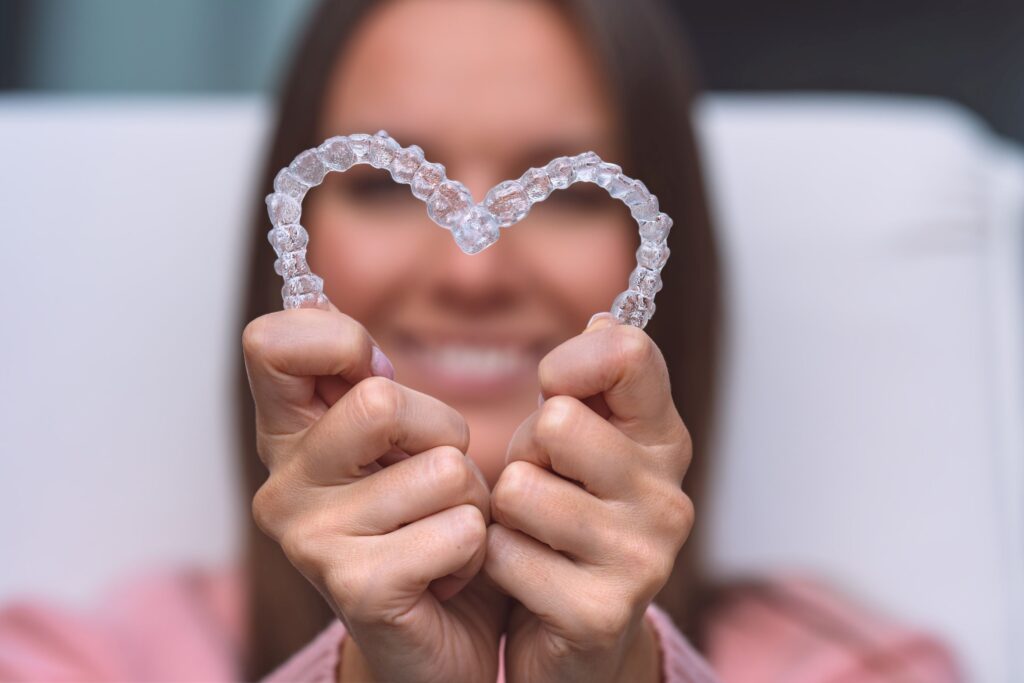
You’re not alone if you want to straighten your smile but prefer to avoid the hassle and potential embarrassment of traditional braces. Sources estimate that between 1 million and 2.5 million people start Invisalign each year.
This alternative orthodontic service uses a series of custom-fitted, transparent plastic trays to gently shift your grin more discreetly. But that doesn’t automatically make it the best solution to meet your unique needs. Continue reading to learn about 3 things you should know about these clear aligners before proceeding with treatment!
#1: You Might Develop a Temporary Lisp
Patients must wear their transparent trays for 20 to 22 hours daily to prevent their teeth from reverting to their starting positions, and it can take some time for your mouth to adjust to this change. It’s possible to develop a temporary lisp during this transitional period until your tongue and the other sensitive tissues become accustomed to your new aligners.
Thankfully, this side effect usually resolves itself with enough time and patience. However, you might be able to speed up the process by practicing speaking or reading out loud to yourself at home. Typically, the more time you spend with your trays in, the sooner you’ll acclimate.
#2: Attachments May Be Required
Historically, Invisalign was reserved for milder misalignments because the plastic trays didn’t provide the same manipulation of movement as standard braces. But this popular treatment has evolved to include additional accessories, like attachments and bands, that can help the aligners grip your teeth more firmly. As a result, your dentist can use this service to address a wider range of concerns, including malocclusions such as overbites and underbites.
These ‘buttons’ usually consist of a small amount of tooth-colored or clear resin bonded to your enamel, which provides an additional anchor. Then, they can typically be smoothed away relatively easily when treatment is complete.
#3: You Will Likely Need a Retainer
Many patients complete Invisalign within 12 to 18 months, but that doesn’t necessarily mean you’ll never need to wear an oral appliance ever again. Your teeth retain a ‘muscle memory’ and are prone to relapsing to their original positions once you stop wearing the trays regularly.
Your dentist will likely provide a custom-fitted retainer to prevent this. These devices don’t exert enough force to shift your teeth, but they can help keep them in place long enough for your mouth to adjust. Some patients are given specific instructions about when and how long to wear their retainer, while others may be required to wear them on an ongoing basis.
If you have additional questions about the process of getting Invisalign or how this popular treatment works, you can learn more by scheduling a consultation with your dentist!
Meet the Author
Dr. Sheren Elsaid is an accomplished dentist who is passionate about helping improve patients’ lives by enhancing their smiles. She earned her dental degree from Temple University and then completed her Advanced Education in General Dentistry through New York University Langone Dental Medicine Program. Today, she offers a complete menu of services, including Invisalign, using state-of-the-art technology for more comfortable, accurate results. You can request an appointment on the website or call (973) 370-5221.